Sunday, September 8, 2019

Blog #1: What is Truth?

“Fiction is the lie that helps us understand the truth.”
― Tim O'Brien
Due date: Wednesday, September 11.
Minimum Words: 350
Remember to cite evidence from sources outside of your own opinion. 
We know that writers, especially non-fiction writers, are supposed to be loyal to the truth. That idea seems simple at first, but as we examine the concept more fully, it becomes apparent that truth is a difficult concept to define.
Here, Ken Burns, a respected American director of documentary films, talks about the difficulty storytellers can have with the truth and how filmmakers tell 24 lies per second to bring an audience closer to the truth.

Ken Burns: On Story from Redglass Pictures on Vimeo.

For the first week of Quest 8 English, we're discussing and expanding on your interpretations of the meaning of Truth. We'll come up with a wide variety of possible definitions and characteristics for the concept of truth, but we were unable to come up with a broad definition that could satisfy everyone. Your first blog entry should tackle this difficult situation.
Take a look at the following questions and respond in any way you choose on your blog. Try to include the word "Truth" somewhere in your post's title. Do not answer each of these questions like they are a quiz. Pick one, none, or a combination of questions and engage with them in a way that shows your developing viewpoint on the idea of Truth.
  1. What is truth to you?
  2. What should all readers and/or writers know about the truth?
  3. What does it mean to be loyal to the truth?
  4. In what ways can a writer best find and report the truth?
  5. Can you find or link to a story/video/podcast that exemplifies the pursuit of Truth.
Your response should be thorough and personal, capturing your unique voice and perspective. Try to write at least 350 words. A true blog will contain links to outside sources or responses to the thoughts of the other blogs in the class. 
Good luck.
Due date: Wednesday, September 11

Friday, May 10, 2019

Blog #9: To Kill a Mockingbird - Reader's Notebook

 This blog post should cover the events of Chapters 1-10 in To Kill a Mockingbird.

Minimum Words: 850
Minimum Text References and Citations: 4 (Including works outside of To Kill a Mockingbird)
Due Date: Sunday, May 19 at midnight. It must be done before the large group discussion.
Note: You are very welcome to include references to other works, including books, stories, videos, music, and other things.

Helpful links: Sample Reader's Notebook from CIS Literature* | Critical Lens notecards  Reader's Notebook Instructions Spark Notes

This notebook entry is supposed to be 100% dictated by your own analysis and relationship to the text. If you can, try to do this without looking at the suggested questions below. However, for those of you who need a little push to begin this voyage, please feel free to consider the following questions or statements:

  • How do the concepts and themes of this novel relate to the world today? What value is there in studying the central ideas of this novel?
  • What does this novel have to say about growing up and developing an identity? What does this book tell us about the way we develop morals, ethics, and beliefs?
  • How much of who we are is where we are from? 
  • How do we truly become ourselves? How should parents balance wanting children to become the people they hope them to be with allowing them to develop into who they want to be? What can we learn from the book in relation to these ideas?
  • Try to apply a critical lens to your reading, the characters, or Harper Lee.
  • Who is the protagonist in the novel? Who is the antagonist? How does the opposition of these characters, ideas, or temes help develop the drama and the unfolding of the tale?
  • How would Boo Radley describe Jem, Scout, and Dill?
  • What motivates the primary characters?
  • Here are some pictures of America during the time frame in which the novel is set. What connections can you make to the text?
  • Take a look at some of the actual artifacts from the Jim Crow era in America. How does this affect your reading or your perceptions of the novel.
  • Why is the book even called "To Kill a Mockingbird"?
  • Analyze Boo Radley's role in the novel.
  • What makes Atticus the way he is. What is his role in Maycomb?
  • How do characters change throughout the novel? How do they remain the same?
  • What's the role of Family in the novel? Pay attention to Ms. Alexandra.
  • Take a look at these Book Club questions if you're really stuck.

Please cite page numbers and specific passages from the novel to support your inferences and conclusions. We will be using these questions and your conclusions, questions, and insights to spark classroom discussion on Wednesday.

Example citation:
Scout says that " Maycomb was an old town, but it was a tired old town when I first knew it" (Page 4). She seems to be trying to emphasize not just the age of the town, but also the slowness of the town, the values of the people, and the way that summer heat made everything drag on.

or
This isn’t the first time we see one of the Price women choosing materialism over God, despite Nathan’s harsh beatings and warnings. On page 363, Rachel reaches for her mirror instead of for her Bible, explaining “[ . . . ] it didn’t seem worth saving at that moment, so help me God. It had to be my mirror.” Whether this shows rebellion or just the simplistic mindset of a 15-year-old teenage girl, I’m not sure. Perhaps she was, in her own, small way, rebelling from Nathan. But maybe she just wanted to make sure that no matter where she went in Africa, she would always know the state of her appearance. That seems pretty likely.


* The sample reader's notebook above is done by a senior in high school with a lot of experience writing these notebooks. It is also over 600 words longer than the entry you are expected to create. No pressure.

Monday, March 11, 2019

Blog #8: Claim, Evidence, and Warrant

Due: Bring a rough draft to class on Friday, March 15
Post your final blog by Monday, March 18
Minimum words: 500
Minimum links or evidence: 3

Note: This blog entry is worth more than the traditional 25 point blog entry. You will be evaluated by more than one person, including members of the Journalism 2 class at Buffalo High School.

For the past few weeks, we've been talking about Claim, Evidence, and Warrant as a way of presenting an argument. If you're totally baffled by this, check out this helpful site that will walk you through it. Also, this page may be even more helpful with examples.

We're pretty awesome at creating arguable claims, and we're starting to get great at Evidence. Warrant is giving us a headache.

Warrant is the "So what?" It explains why your evidence is important and how your evidence connects to your claim. It makes a claim convincing.

Your task? It's easy.

Choose a topic. It could be the same as your Satire topic, something that can help you with your nonfiction project, or just something you're interested in. Then, you get to engage it with informational writing using Claim - Evidence - Warrant.

  1. In the first paragraph, make a clear, strong, and arguable claim that you actually believe. Preview a couple of things you'll argue or support. 
    1. Claims of policy or solution.
    2. Claims of fact or definition.
    3. Claims of value or worth.
    4. Claims of cause and effect. 

  2. Provide valid evidence for your claim from authoritative sources and link to that evidence. Try to make a paragraph for each piece of evidence or pillar for your support. If you are bringing in evidence that can be linked to, turn your text into a link. Use signaling phrases for bringing in evidence like
    1. According to _________, 
    2. In a study done by _________,
    3. Jenna Smith, a researcher at the University of Minnesota, discovered that _________
    4. A 2019 survey of over 80,000 American teenagers by the Pew Internet and American Life Project revealed that ______________.

  3. Provide warrant with each piece of evidence that explains for your reader why the evidence you're using is valid and how it connects to your claim. 

  4. Anticipate a counter-claim and briefly argue against it, explaining how your argument is better through evidence and warrant.
  5. Provide a strong conclusion that reiterates your claim and leaves the reader with a path to follow. 
I ask that you make a claim that you actually believe in or one that you actually can support. Remember that an arguable claim is one that can be debated, so go ahead and pick something that not everyone agrees with you about.

Your writing should be polished and your evidence should be sound. You should put emphasis on proofreading your entry and work toward having a clear and audience-friendly final draft.

Need help? Try it first!

Wednesday, February 27, 2019

Blog #7: Good Leaders, Good People, Power, and Empathy - Julius Caesar

Due Date: Sunday, March 3
Minimum Words: 500
Outside links required: one
Correctly cited text references required: 2

For the complete text of Julius Caesar, with both the original text and the modern translation, check out No Fear Shakespeare: Julius Caesar.

Consider the story of Julius Caesar and reference it as you respond to the text. Your response should focus on the ideas of Power and Leadership.


Make sure your writing has a clear claim near the beginning and that you introduce your topic fully. You need to give context to your audience at the start of your writing so they know what you are writing about what you may be trying to prove.


Here are a few questions if you need an idea to get you started. You can go in depth about any of these or combine them into your own questions. Don't treat this as a quiz and answer every question.

  • What modern connections can you make between Julius Caesar and the idea of leadership today?
  • Antony, another member of that ruling class, is also one of the more sympathetic characters of the play. But is he a good ruler?
  • Does this play portray an ideal leader? Does it give any clues about what an ideal leader could be?
  • What is the difference between a good person and a good leader? Are those two things mutually exclusive in certain ways? Are there ways that good people cannot be good leaders and good leaders cannot fully be good people? What implications does this have on your views of leadership?
  • What kind of leader is Julius Caesar? The conspirators say he's a tyrant headed for absolute power. Is there evidence in the play to support this? Is Caesar really a threat to the Roman Republic? Why or why not?
  • Were the conspirators justified in removing a leader who has the potential to be a tyrant?
  • What relationship is there between leaders and those who are led (or, perhaps, followers)? What does this play suggest about the people's ability to choose leaders and the choices they make for themselves? What do the Plebeians suggest in this play?
  • What connections can you make between "A Good Man is Hard to Find" and Julius Caesar?
  • What connections can you make between "Report on the Barnhouse Effect" and Julius Caesar? 
  • Are there advantages to ambition? Do we need to be more accepting of character flaws of our leaders?
  • If, as neuroscience is proving, leaders suffer from reduced empathy responses, what can leaders do to stay compassionate? Whose job should compassion be? What is the role of a follower or a person who is content to be led? 


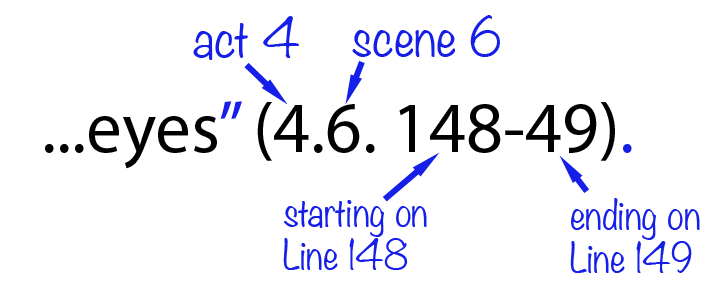
Here's how you cite examples and lines from the play:

You will receive extra credit points for attempting to quote a passage from the play in the correct format.

25. Verse play or poem For verse plays, give act, scene, and line numbers that can be located in any edition of the work. Use arabic numerals and separate the numbers with periods.
In Shakespeare’s King Lear, Gloucester, blinded for suspected treason, learns a profound lesson from his tragic experience: “A man may see how this world goes / with no eyes” (4.6.148-49).


Wednesday, January 2, 2019

Blog #6: Creating Satire

Due Date: Monday, January 7
Minimum Words: 550 - However, other formats besides writing may be used
Links: Optional, but helpful if you're going to have fun with the tone in a "real" blog.

What is the biggest rock? This is the most important question.


Start here for an excellent video that defines what satire is and gets you a head start on how to make your own.

Here's an example of satire, outlining the tortures of Teenage Affluenza.


Jon Stewart, who is a modern master of Satire, explains about his relationship with it here.


Your assignment is to create an original piece of satire on a topic of your choice.

It can be written as an essay, an article, a poem, or a song. It could be performed as a piece of music or speech, it could be a video done alone or with partners. It could take the form of anything you please.

Feel free to label your post as Satire if you are worried about your audience forming the wrong impression about you. However, if you truly want to do this well and have your intended effect, you may want to avoid the label.

Monday, December 17, 2018

Blog #5: Logical Fallacies

Due: Thursday, December 20
Minimum Words: 400
Links Required: Your Group's Fallacy Video and perhaps your presentation
Find videos here & here.

For this post please embed your group's fallacy video and strongly consider embedding your Fallacy presentation. This is a great chance to turn your blog into a portfolio.

After you include your work, come to some conclusions about how Logical Fallacies relate to problem solving, debates, or influence. If you need help coming to a conclusion or getting started with your writing, please consider the following questions:

  • What has studying logical fallacies taught you about reasoning, debating, and argument.
  • Where have you encountered logical fallacies in your life? 
  • What fallacies do you find yourself using?
  • How can understanding fallacies make you a more prepared thinker or debater?
  • Why do you think logical fallacies are used?
  • How can understanding fallacies help with problem solving?
  • How can people best use debates and discussions to promote problem solving instead of creating deeper divisions? How can understanding logical fallacies relate to this?
  • Why are debates and discussions so difficult sometimes?
  • When have you seen fallacies used correctly?

Tuesday, November 27, 2018

Blog #4: Happiness and the American Dream

Due: Thursday, November 29
Minimum Words: 500
Minimum Quotations or Paraphrases from works we've read in class: 3
Minimum Links to outside sources: 1

Your evidence from texts needs to be cited properly. Please refer to Purdue's Online Writing Lab for the way to do this correctly.


We all want to be happy, right? But, what happens once we get there?

Happiness is a huge topic. It's the subject of movies, books, music, and countless conversations. You think about it when you pick your friends, your hobbies, and how you relate to others.

Writing this blog prompt is difficult for me, because my friends came up with over 100 important questions about happiness, and the class generated over 60.

So, here's what I'd like for you to do this week. Consider what we've done in class; the stories we've read, the conversations you've had, and the activities we've done. After that, come to a conclusion about the pursuit of happiness and share it here. Connect multiple sources in your writing to use as evidence to support your points.

Here are some possible themes to consider:

  • The pursuit of free, easy happiness with minimal effort.
  • The relationship between happiness and perfection.
  • The dynamic between beauty, nature, science, and technology.
  • The transcendental philosophy of the Happiness of the Journey; Happiness in Imperfection; Happiness in Location; and Happiness in Nature. 
  • The American Dream and the Pursuit of Happiness. 
  • The way we can truly achieve lasting happiness. 
  • Other conclusions you've made about the idea of attaining happiness. 

Reference what we've done, your own thinking and experiences, and outside sources that connect to what you're thinking about.

I'll try not to ruin this one by asking too many questions.

Good luck.

 Things you can and should reference in your blog: